

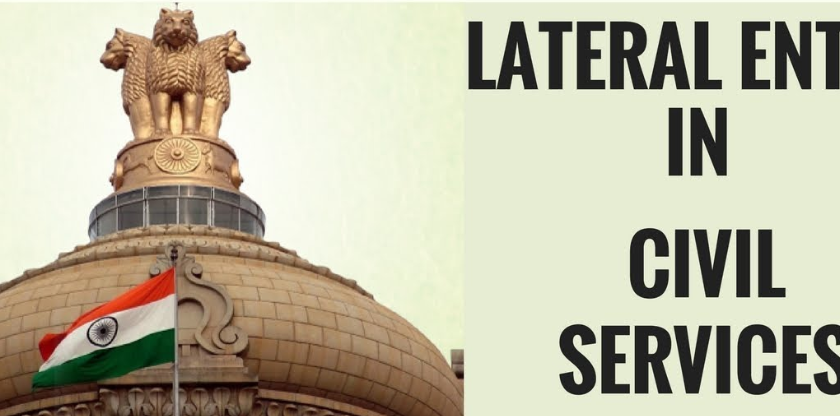
Lateral entry into Civil Services: A decision to be welcomed or an attempt to privatise the bureaucracy?
Ever since the Central government has given a green flag to the lateral entry of the individuals with expertise in a specific domain into the bureaucracy at the central level, a debate has risen over the efficacy of this move with many hailing it as decisive step brought about in a bid to reform civil services and others criticizing it for bypassing the conventional procedure of the entry of civil servants and many other reasons discussed later in this article.
This is not the first time that the centre has invited the private individuals to offer their services in the government in various posts. In the past, we have had the examples of Raghuram Rajan, Manmohan Singh and a few more whose services have been availed the centre in a similar manner. Those welcoming the decision of the central government to fill the posts of joint secretaries and other posts in the various departments at the centre through lateral entry argue that with the entry of people with special acumen and knowledge in a particular domain, the concerned department will function more effectively.
The common perception about the civil servants is usually of being “generalists” rather than “specialists”, which is in fact true to a great extent as civil servants are usually allotted groundwork in the formative years of their career, where they are given the responsibility to keep a check on the of various departments of the districts. And the time they get promoted to the centre to offer their services in the last leg of their career, they are entrusted with a responsibility to head a department so specific about which they may not have much nuanced and specific knowledge.
They might have studied the subject concerned with the department in their college prior to appearing for civil services, and they may be even the gold medalists in their respective fields of study such as engineering, medical, management etc. But once they get into civil services, the nature of their job becomes so generalists that their specific knowledge of the subject is not utilized to the extent to groom and convert them into specialists per excellence to head a particular department.
Because unless the knowledge we possess is applied, neither it expands nor does it yield any result. Besides that, it has been seen that after making to the civil services at a very young age, civil servants have been alleged to be bit complacent, unenthusiastic and lackluster in the job performance with the passage of time and due to a sense of security and lack of any severe measure of punishment, except transfers, for deterioration in the performance. Which is why they are said to be lacking the innovation and sense of competition which could bring the best out of the system in the higher echelons. Another argument given in favour of this move of the centre is the shortage of IAS and IPS officers in the country, as pointed out the Baswan Committee. And the later entry could resolve this issue of dearth of officers to a great extent.
Though, prima facie, lateral entry, the decision to open a window of opportunity for those willing to serve as the joint secretary, deputy secretary, and director in the departments at centre seems to be all good and innovate. However, yet a common consensus hasn’t been made about the efficacy of this decision. In fact, many people are skeptical about the very intention of the government. They accuse the government of privatizing the bureaucracy and chances of promoting favouritism and lack of transparency in the selection of the bureaucrats bypassing the conventional procedure establish UPSC.
The association of bureaucrats of the country has also expressed their displeasure over lateral entry citing it as a decision that will undermine the role of civil servants who work tirelessly for decades on the grounds. By recruiting an outsider at the top of the helm who isn’t yet experienced enough about the basic ground problems that surface in the execution of policy, the centre is discrediting and underestimating the contribution and talent of the civil servants. People opposing this move have been arguing that in order to head a department, one doesn’t necessarily have to be an expert in the technicalities. They say that it’s not the technical expertise, but the ability to manage and handle that counts the most. And the huge gap between the policy-making and its implementation can be bridged better only those who have the rich experience of both.
In a nutshell, it can be concluded that despite a few lacunae in the proposed system of lateral entry, it has the potential to address the key challenges our existing bureaucracy face today. It not only calls for a competition amongst the individuals with expertise in the specific domain at the higher level but can also motivate the civil servants with utmost honesty and diligence to get into the higher echelons of power.
Having said that, it’s the responsibility of the government to keep the process of recruitment for lateral entry as transparent and clean as the recruitment for civil services done UPSC. Only then the civil servants, who are selected after passing three rigorous stages of the exam, and those opposing this move on the grounds of the transparency and motives will have no qualms and problems with this process.
Apart from that, there could be some relaxation in the norms for civil servants who are restricted to outside the government with multilateral agencies, non-profit organization and corporations, as it will help them develop a distinct expertise in a particular field.

Currently, I am pursuing B.A(H) Political science from Satyawati College, Delhi University.
I like public speaking, writing and reading in my leisure.


